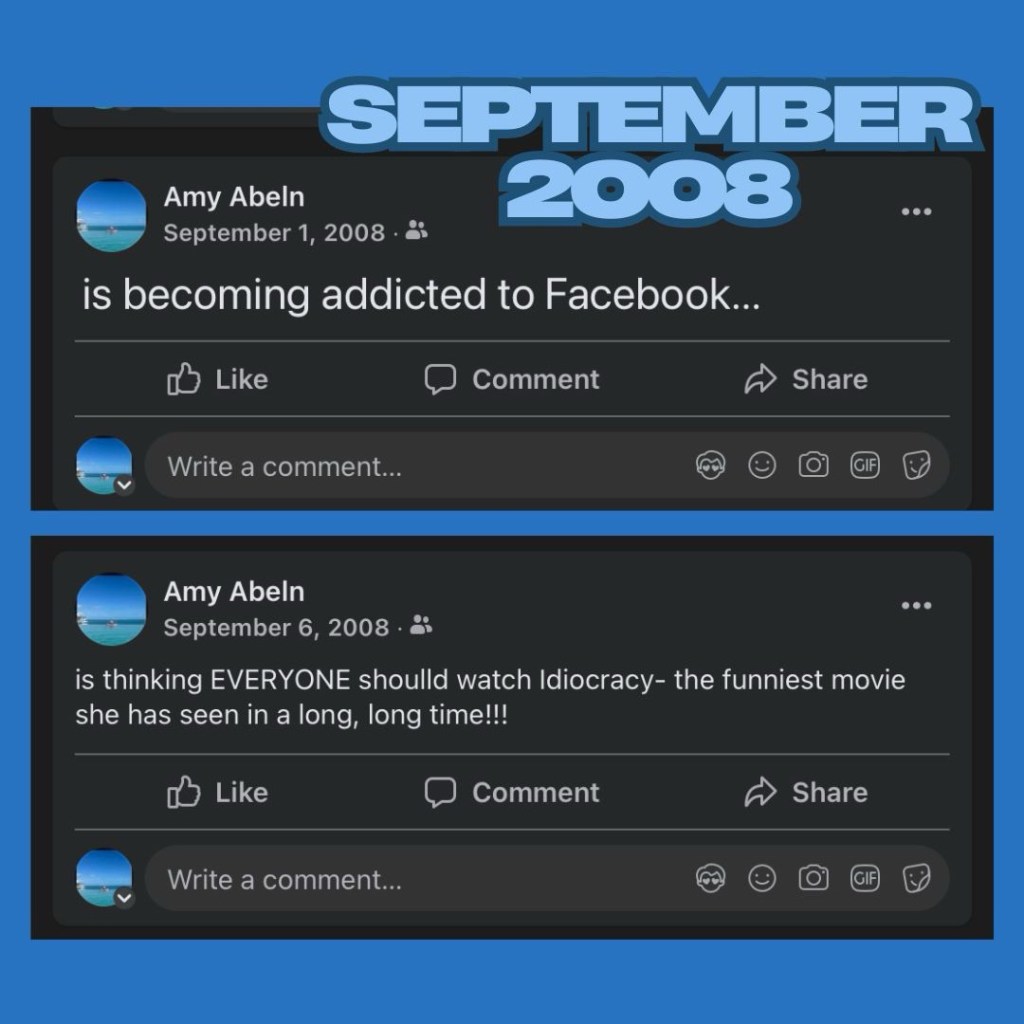
In 2008, two seemingly unrelated events occurred in my life: I watched the movie Idiocracy and joined Facebook. Idiocracy seemed so far-fetched at the time, satire about a society too consumed by junk food, memes, and mindless distractions to engage in critical thinking. And they wore Crocs, FFS! Facebook seemed like the opposite: I was reconnecting with old friends I hadn’t talked to in years. Facebook was a tool; an optimistic dream come true of how technology could bring people together. But looking back, it’s hard to ignore how closely they’ve become intertwined.
Facebook’s journey reveals something more profound about society and how tools meant to connect us can instead reflect our flaws. To understand why, let’s dive into some history. Facebook began as an exclusive club open to elite college students, and its early features were about ranking people’s attractiveness. Beneath its shiny promises of connection lay a focus on status, appearances, and performance, not authenticity. And as it grew, that foundation didn’t change much. Algorithms began prioritizing what got the most attention. Uplifting or toxic, it didn’t matter, and never will, because attention drives profits.
Funny enough, this pattern mirrors America’s own history. Take Jamestown, the first permanent English settlement in what would become the United States. Most K-12 American History classes frame our founding as a noble experiment in democracy, but it wasn’t. It was a corporate takeover; a colony funded by investors seeking profit, not freedom. The settlers were less interested in building a fair, sustainable society and more focused on extracting the cheddar to send back to England. The French were in the north; Spain had Mexico, and by God! England was going to get a piece of that new world cheese.
Both Facebook and Jamestown started as commercial ventures. Both later rebranded themselves as something more noble: one as a tool for connection, the other as a land of opportunity. However, foundations built on exploitation and surface-level virtue are challenging to transform into something authentically good.
When Idiocracy imagined a future dominated by junk culture, it was meant as an exaggerated joke. No one seriously thought we’d replace meaningful conversation with slogans or education with entertainment, but no one thought we’d seriously start wearing Crocs, either, yet here we are. And as social media exploded, that satirical future became eerily familiar. Platforms like Facebook and Instagram flattened our communication, turning complex issues into bite-sized arguments, memes, and outrage. I’ve posted my fair share of posts provided by algorithms designed to keep us scrolling, rewarding controversy over cooperation, and spectacle over substance.
And here’s where Idiocracy and Facebook intersect: both reflect a world where we’ve turned connection into a game. We all crave likes, comments, and shares not because they lead to a deeper understanding of one another but because they trigger the same part of our brain that lights up when we eat candy or win something. It’s a feedback loop that keeps us clicking, even if it leaves us feeling more isolated and frustrated in the long run.
This might sound bleak, but here’s the good news: the tools themselves aren’t the problem; the people are the problem, per usual. Facebook and the internet as a whole still have incredible potential. Imagine if more of us stopped chasing likes and started using social media to build meaningful connections. I think about it all the time.
Viral trends and political clips get attention, but real change happens in the small, steady actions people take. Relationships grow through daily conversations. Movements succeed because people consistently show up, even when no one’s watching. The same is true for social media.
The past two decades have been a wake-up call. We’ve seen how powerful tools like Facebook can be used for positive and negative outcomes. The question now is how we’ll use those tools moving forward. Will we keep falling into the trap of shallow engagement and performative connection? Or will we reclaim technology as a force for real, meaningful change?
The choice is ours in the small, daily decisions we make. Every time we scroll, post, or comment, we can shape the kind of world we want to live in. So, let’s imagine a future that rejects Idiocracy and embraces something better: a future where we use technology not to distract ourselves but to build a brighter, kinder, and more connected world. After all, the real revolution isn’t about tearing everything down. It’s about showing up daily with intention and using even the smallest tools to create something transformative.
Discover more from Mocktail Hour with Amy Abeln
Subscribe to get the latest posts sent to your email.
