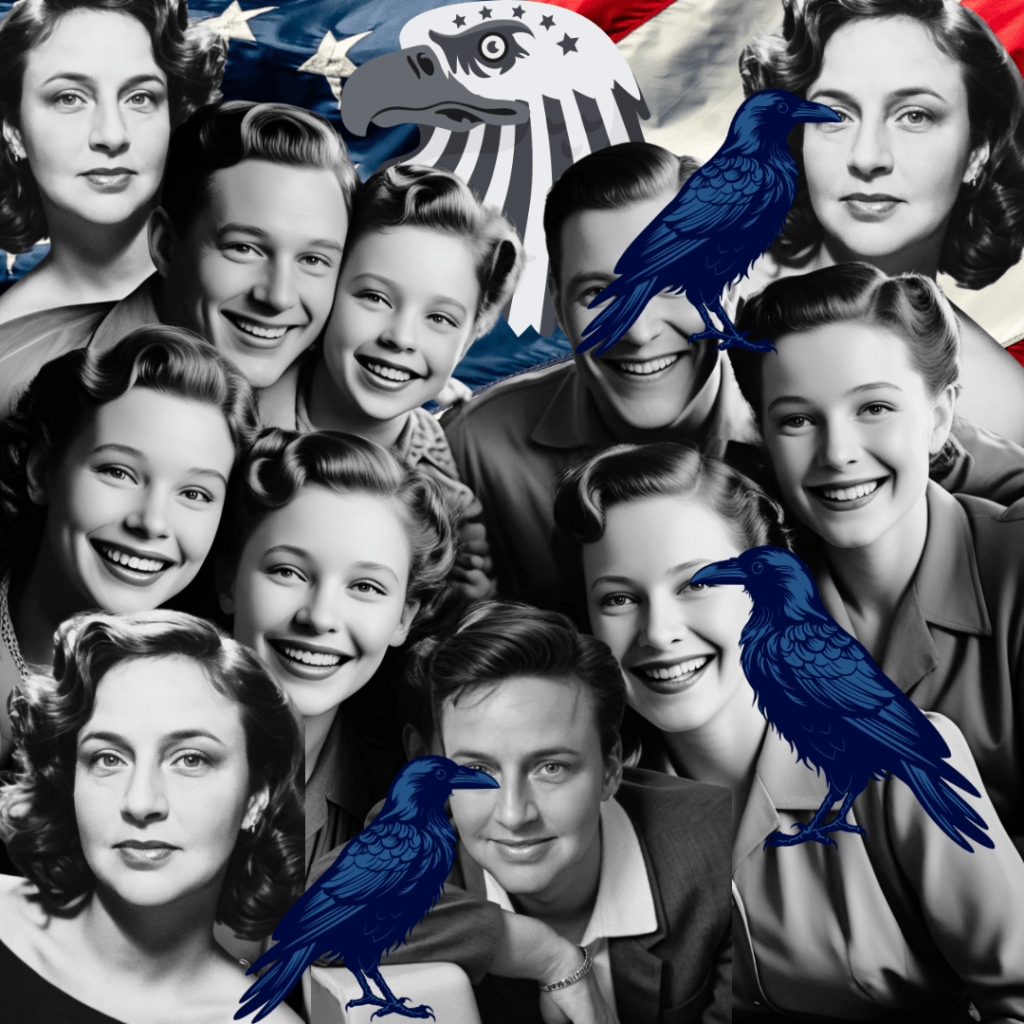
The shame hit fast. Not because I looked bad in the picture, I didn’t. I looked familiar. I’d used one of those filters that morphs your face into a 1950s man, half as a joke, half as an experiment. The image stunned me. I looked like a ghost from someone else’s past. So I sent it to my mom. I expected a laugh.
She wrote back: “Wow. You look just like Tommy Lee.”
My guts roiled.
Tommy Lee isn’t the celebrity rocker you’re thinking of. He’s family. My mom’s cousin. Which makes him mine, once removed, though never far enough. He’s the kind of man whose every sentence comes dusted in racism, gender dominance, and nostalgia for a world that should never have existed. I won’t recount his words. They don’t deserve the dignity of repetition. Fortunately, I didn’t see him often. My mom steered clear and quietly said he wasn’t nice. But she remembered him enough to see his face in mine. It felt like a black eye.
Resemblance isn’t just visual. It’s ideological.
When she said I looked like him, I didn’t hear a comment on symmetry and genetics. I heard a truth I’ve spent most of my life trying to outrun: you come from this.
My father’s side is German and Irish,1800s immigrants; my mother’s side is Pilgrims and Jamestown. The settler-colonial legacy is so deeply rooted that it bypassed memory and became a belief system: something embedded. There is no renouncing it, only calling it out.
Still, I ache for home. Because my family, mostly neoliberal, Protestant, Southern-inflected, is also fun. We are card tables and BBQs, lake houses and bocce ball. We are sunsets, wet swimsuits on the dock, and mimosas before noon (OJ for me). We are laughter. We are joyful. We are silent. We do not talk about what happened to us, or through us. The trauma is dressed in a casserole and served politely. There is always room for another plate, another drink, another laugh. There is never room for honesty.
That’s the betrayal I’m reckoning with. Not that I resemble Tommy Lee, but that I know the comfort of the world that made him. I still find pieces of myself shaped by its contours. I was taught to find safety in the order of things, to keep the peace and maintain the performance of decency at all costs, even when it feels wrong.
And that’s how I know Gloria.
Gloria sits at the edge of the yard like an exclamation mark: rigid, unreadable, always present. Every July for twenty years, we’ve shared a resort in northern Minnesota. Same week. Same rituals. Same unsaid rules. Gloria doesn’t yell or scold. She never confronts anyone because she doesn’t have to. Her silence is administrative. Her gaze is a ledger. She doesn’t file complaints, she is the complaint.
Years ago, when Freddy was a puppy, he dashed across the yard, peed on her chair, wagged his tail, and stole her chips. We laughed. She did not. She wiped the chair with antiseptic wipes pulled from her beach bag and walked away. We never spoke of it, but the receipt was filed away.
This summer, her adult son reported Freddy for “nipping” his child. There was no blood, no tears, just the necessary disruption to justify escalation. He filed the report. The lodge manager delivered the consequence. Gloria stayed seated because she had already trained the system to respond on her behalf.
This is her genius. Gloria doesn’t govern through force. She governs through structure. Minor infractions, silently recorded, reappear as formal consequences years later. She doesn’t argue. She replicates and delegates. Her son wasn’t just passing on a concern but carrying out a doctrine. He was the transmission.
She never raised her voice. She raised a child who knows how to weaponize a process.
This is how patriarchy survives: through the women who were trained to keep things proper, women who fold their fear into policies, turn discomfort into criticisms, and uphold systems they will never lead, only administer. Gloria doesn’t need a badge. She’s fluent in procedure. She keeps the complaint close, lets it ripen, and then submits it when it can do the most damage with the least mess.
I know her because I was trained the same way.
Women like us were taught to be likable, helpful, and appropriate. We were trained in plausibility. We were given the script and told that survival depended on sticking to it. Gloria followed it perfectly. I went off-book, but I still remember the lines.
Gloria remembers everything. Her memory isn’t soft or story-shaped, it’s structural. It doesn’t hold warmth, it holds precedent. Her silence is a catalog of who failed to comply and when. She doesn’t keep a journal, she keeps receipts. Her performance is submission dressed as virtue, and it works.
This annual family vacation has unraveled over the years. The joy is thinner. The laughter quiets. The silence arrives earlier each day. And Gloria never stopped watching.
She’ll never admit it, but I think it felt like justice. Obedience is a fragile identity; anything threatening the order it’s built on feels like an attack. Gloria doesn’t hate my dog. She hates the disorder he represents: the freedom, the joy, and the refusal to defer. She needs a villain because she cannot bear to ask whether the rules ever served her or if she just disappeared into them.
I understand the ache of that question. I see the resemblance.
And this year, I didn’t flinch.
When her son filed the complaint and the manager came over, I didn’t protest. I didn’t soothe. I didn’t adjust.
I met Gloria’s gaze and let her know: I remember, too.
If women like Gloria keep the receipts, I will annotate the margins.
Tommy Lee and Gloria aren’t opposites. They’re carriers. He through explicit ideology. She through procedural behavior. And so am I, if I’m not paying attention. What links us isn’t personality, it’s function. We’ve each been taught to uphold the systems that shaped us, to enforce harm while calling it tradition, order, decency.
The only difference now is that I’m done pretending not to notice.
Discover more from Mocktail Hour with Amy Abeln
Subscribe to get the latest posts sent to your email.

Good morning,I really enjoyed mockta
LikeLike
Thank you so much! 🐦🔥
LikeLike