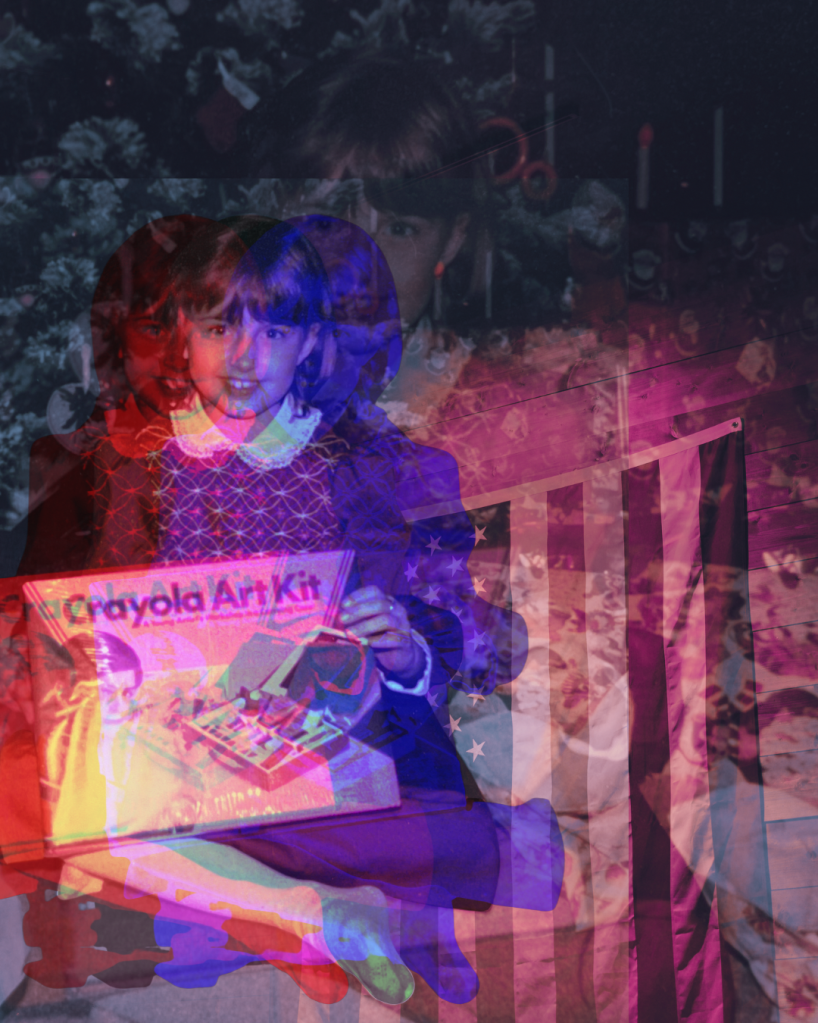
I grew up inside of a song so familiar that it never seemed like a song at all. It was some old, forgotten tune that settled over the house like the faint hum of appliances—a mild dissonance—present, unexamined, shaping my soundscape without asking to be noticed. I didn’t understand that I was hearing my inheritance. Back then, it felt like atmosphere: the low drone of Carter’s voice on the television, Reagan’s practiced smile on the evening news, my dad insisting one man would make us strong, my grandma murmuring that the other carried the steadiness the world needed. Their disagreement never frightened me outright. It was more like the change in pressure before a storm—subtle, tightening, something my skin registered before my mind could. Adults spoke about danger the way they talked about the weather. It could turn. It could ruin everything.
I mastered early on how to fold myself into the unnoticed spaces. Under the table with its lemon-cleaner smell. Behind the grey flowered sofa, where dust settled in the weave. From there, I watched the grown-ups’ shoulders rise and fall as the news mentioned Russia. The Cold War lived in my grandma’s house like an extra piece of furniture. I didn’t have a name for it. I only knew the air stilled in the room whenever the anchor mentioned missiles, hostages, the wrong leader gaining ground. Their fear traveled through them and into me, not with their words, but through the quiet tightening of their breathing.
Other lessons arrived the same way—soft, unannounced, absorbed through osmosis. The porch flag told us who we were without saying a thing. The flower beds were evidence of care and of the order we were expected to maintain. Whiteness worked like that in my childhood: a map of roads taken and roads avoided without explanation. I didn’t know it was an ideology. I only knew which neighborhoods made the adults’ voices shift, which names made them tell jokes or speak in coded tones. I breathed these fragments.
What confused me most was how love fit into the fractures. I was told to love thy neighbor as thyself. Just make sure you have the right neighbors. I was told to love the people whose arguments sent static through the room, to trust their certainty even when it pulled in opposite directions. The distance began as something I felt across the living room; eventually, it opened inside me, too. By six, my body registered tension long before I knew a word like anxiety.
Some truths arrived as whispers children weren’t meant to hear. I learned about death from the corners of conversations—my aunt had “lost” a baby, though no one said what that meant. My cousin said the baby had died inside her, and I understood instantly that “lost” was a shield adults used for themselves. The wrong words cast soft shadows over hard things. Saved meant forgiven, not rescued. Proud meant frightened of anyone different. The adults navigated their world in a language thick with avoidance.
I hold a memory of a Sunday supper—election season, chicken frying on my grandma’s gold stove—the house felt charged in a way I sensed even then. The TV leaked commentary into the kitchen, a drifting storm front of voices. Grandma and Grandpa had taken me to see Jimmy Carter by the river the summer before. He pressed a Twinkie into my hand, slid a plastic Twinkie ring onto my finger, and smiled as if he recognized me. Grandma said he carried decency. My dad said Reagan carried strength. The house held their disagreement like I held my breath underwater.
I moved to the window where Grandma stood, staring into her backyard as if it might answer something for her. The yard was her private archive: flowers arranged with intention, trees grown from saplings, plants that carried lessons she never stated aloud. Honeysuckle is sweet enough to sip. Hydrangea is poisonous enough to kill. These were my first lessons in danger—the yard breathing instruction beneath the surface of ordinary days.
I set the table with my great-great-grandmother’s china, wiping each plate as if clearing a film from the past. Grandma once said her grandmother owned people in the 1800s. She told it flatly, as though reporting time and temperature. After emancipation, she said, those families stayed on because they loved them. Her voice softened in a way that made the story feel both smaller and more frightening, as though time itself had been used as a solvent.
I repeated the story to a friend at school, thinking I was offering some neutral historical fact. I told her it was weird to think that my family could have owned her family. Her face froze. The silence from her that followed taught me something the adults never had: history does not leave everyone with the same stories.
The Sunday tablecloth was cream-colored and stiff with starch. Grandma said any stain could be removed if you scrubbed long enough. I believed her. I wanted to. The idea that nothing marked permanently felt like a promise. I am embarrassed to admit that belief held longer than it should have.
In those same years, at the end of Reagan’s first term, the Air Force moved us to Germany. The split inside me traveled overseas. My teachers said we were peacekeepers with the confidence of people who had rehearsed the word. My dad spoke of strength. Chernobyl smudged the sky. Gaddafi filled the news. Nuclear drills shaped our school days. The Challenger exploded while we watched.
The base felt like a replica of America placed on foreign soil—expansive lawns, clipped hedges, commissaries stocked with cereal brands from home. Each day, I passed through the gates with my laminated military ID, which granted me clearance. The guard lifted the barrier because my picture was enough. I felt chosen. Important. I didn’t yet understand that this was how an empire teaches its children to confuse access with self-worth.
It took years to understand why we had bases all over the world and no one had bases in our country. My childish questions were met with clipped answers, then with directives to stop asking. As I learned later, the adult truth was simple, but avoided: we were where the oil was, where alliances needed reinforcement, where American interests required visibility backed by force.
When we returned to the States, the garage radio carried Rush Limbaugh whenever my dad was home. His laughter filled the garage, a feeling both relieved and sharpened. Reagan had already made cruelty sound pragmatic. Limbaugh made mockery sound like common sense. Their voices wrapped around my teenage years like insulation—quiet, consistent, hard to peel away.
College cracked that insulation. Marx, Arendt, Gramsci—they gave me language for the tension I carried since childhood. I told my dad I was taking a course on the Literature of Socialism. He asked me in a fearsome yell, “What the hell do you think I fought against for the last 20 years?” He wasn’t asking for an answer; he was demanding I correct my thinking. Even after I’d enjoyed the benefits of socialism offered by the military for my entire life—cheap groceries, free health care, and affordable housing—the silence that followed felt like a border checkpoint neither of us could cross.
Somewhere in those years, another clearance tag appeared. I wore a dress I adored, felt radiant in it, then felt the plastic tag brush the back of my neck as a friend tucked it in, the bright red markdown exposed. Shame arrived instantly, sharply. I digested something essential without knowing it then: something could be valued and still diminished. Something could look expensive and still be marked down. Pride and cheapness could coexist in the same object.
As I grew older, the clearance tag kept showing itself, not just on that dress but on every story I had been taught to trust. It clung to the myth of American innocence and to the tale of the self-made man that collapsed the moment you pressed on its inherited advantages. It hung in living rooms where respectability softened the racial lines no one admitted were there. It fluttered behind the nostalgia that remembered Reagan fondly because it refused to acknowledge what his version of America actually cost. He had taught the country to prize the shine over the substance, to choose the performance over the people, to believe greatness was real simply because it photographed well. That was the cheapness. That was the markdown disguised as pride. The clearance tag revealed the true price of the story: the access I enjoyed as a military kid, the whiteness that defined who felt safe and who was scrutinized, the class signals mistaken for character, the Cold War certainty that our force was steadiness rather than fear, the family insistence that any stain could be erased if you worked hard enough. All of it bright on the rack, discounted in the hand, a version of worth that depended on not looking too closely at what held it together.
I didn’t become a leftist by rejecting my family. I became one by understanding the debt embedded in the familiar tune that raised me. The girl who believed Carter could keep the world from ending and Reagan could keep the Russians from killing us grew into a woman who sees that both parties operate the same machinery, just in red or blue. The girl who heard slurs slip casually from her grandfather’s mouth grew into a woman who studies the systems that make such language possible. The young adult who listened to corporate men brag about ownership grew into a woman who sees the emotional economy their pride requires.
Children don’t choose belief. Belief is the first survival mechanism handed to them, a way to stay aligned with the people who feed and shelter them. Questioning arrives later, slow and unsteady, a kind of internal rerouting that hurts as much as it clarifies. My shift from patriotic military kid to leftist adult never felt dramatic. It felt gradual. I sensed the dissonance long before I understood it. I understood it long before I could speak it. I spoke it long before I knew how to live it. I try to live it now while loving people who would rather I stay the version they once recognized.
I can still see my grandma at the sink, staring into the yard as if the plants held an answer she couldn’t bring herself to voice. I can hear my dad laughing along with men who built their humor on the diminishment of others. I can feel the weight of my friend’s silence after I repeated the history my family treated as harmless. I can feel the clearance tag graze the back of my neck, an old signal, a quiet truth. These images make up my inventory. My work now is to take stock of it, keep the tag visible, and remember the real words to the forgotten song, for the rest of my life.
Discover more from Mocktail Hour with Amy Abeln
Subscribe to get the latest posts sent to your email.
