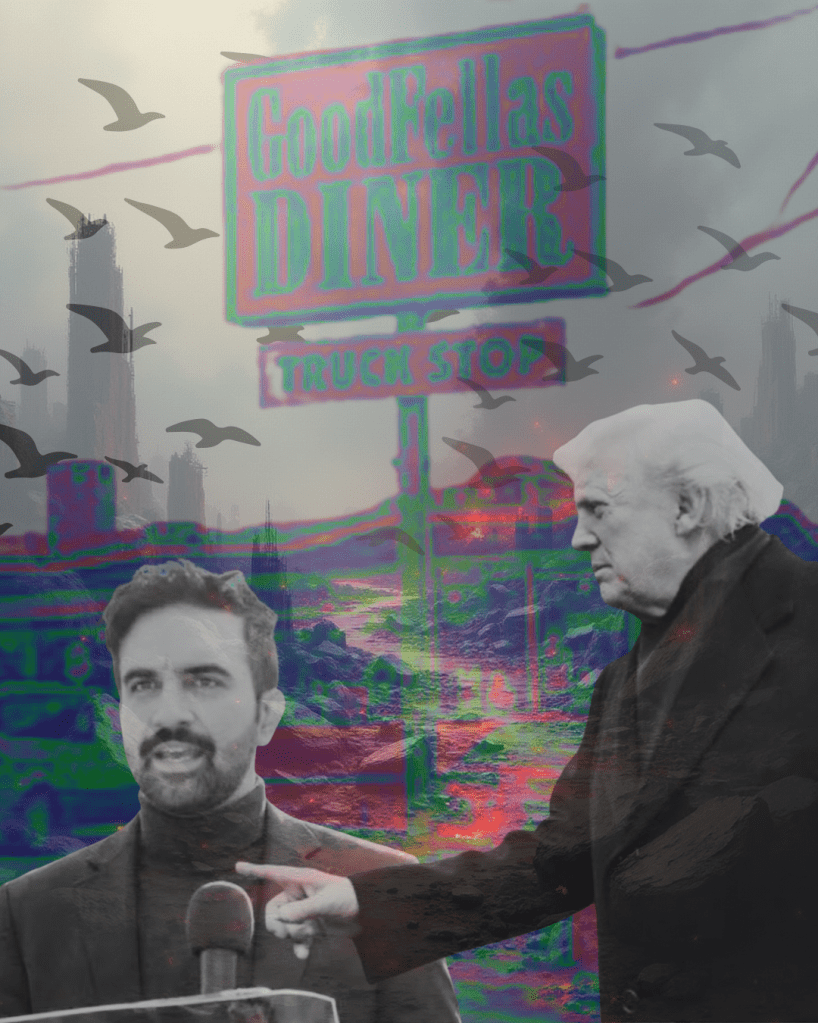
The Oval Office scene between Zohran Mamdani and Donald Trump flitted across our feeds like a collective hallucination. People called it surreal, comic, and uncanny. They replayed the clip for its awkward charm. They laughed at the improbable warmth that surfaced between a socialist mayor from Queens and a president who had spent a lifetime fashioning his politics from the ache of being excluded. The strangeness made an easy story. What it obscured was the quieter truth in the room. Mamdani did not enter as a Democrat confronting a Republican. He entered as someone shaped by the same city that shaped his host. He stepped into the private emotional realm of a man whose adult persona still revolves around the unresolved fact that New York never loved him back.
We felt this as soon as the door opened. It lived in the minor adjustments of his posture; in the charged pause before his words arrived; in the familiar exchange of two men who share a world even as they inhabit different political galaxies. Their interaction carried the accent of place—teasing, swagger, territorial softness. They were using a vocabulary older than party lines, rooted in a shared emotional inheritance.
The Oval Office typically compresses visitors into reverent silhouettes. Mamdani refused that script. He moved with the right to breathe the same air as the man behind the desk. That kind of ease is a New York education: learning to stay centered while louder men perform their versions of dominance; knowing that noise is not authority; learning that confidence and truth do not always hold hands. I spent a short few days in Queens in the Way Back When, and she didn’t fuck around. Queens teaches you to observe without absorbing. Mamdani carried that knowledge into the room, and Trump recognized it instantly. People usually approach him with fear or hostility. Mamdani brought neither. He arrived fluent in the emotional landscape before anyone spoke, because he knew the type long before Trump became a national figure. Trump sensed this before his mind could narrate it.
What followed was not politics. It was a glimpse into each man’s internal logic rather than the public-facing versions of themselves. Years of time on the couch with my own analyst have taught me to watch for the somatic slip, the place where one’s posture reveals a more profound truth, the moment when a practiced persona falters and something older rises to the surface. That is where this encounter lived.
Trump—for all the violence he’s enacted, endorsed, or threatened—moves through the world with a neediness visible in every encounter. Clinically, he presents less as an ideologue and more as someone who built an adult identity around an early humiliation he never metabolized. His projection of certainty is his armor. His outer-borough worker bravado is not an identity he inhabits. It is something he puts on, hoping the costume will fuse with his skin. The mythology compensates for the exclusion he experienced. It shields him from the city that formed his primary object of longing—the city he still wants to impress—the town that punished him again and again for the gap between what he wanted to be and what he actually offered.
This is why Mamdani’s presence unsettled him. Mamdani did not challenge the myth. He embodied the ease Trump has tried to counterfeit for decades. Trump encountered the real object his defensive persona was designed to imitate. His body recognized the difference before language arrived. His shoulders lowered. His jaw softened. His voice shifted into the affectionate tone he reserves for rare moments when he wants to be addressed as a person rather than some kind of god. The shift was not admiration. It was relief. It was regression. This was the return of an unmet attachment pattern stirred by proximity to familiarity, not politics.
Regression explains everything that followed. Trump was not responding to Mamdani’s policy positions. He was reacting to the fantasy of being recognized by the city that shaped him. The desire was old. The wound was older. New York has known him too long to believe the myth he curated. The city remembers the inheritance he inflated into self-invention—the legal evasions, the unpaid contractors, the appetite for spectacle without corresponding accountability. Workers kept their own stories. Manhattan’s elites kept theirs. Hundreds of women have theirs. Over time, the city became the original object that withheld affection, and he returned that withholding with scorn for its diversity, its messiness, and its refusal to adore him. Yet he still wants the recognition. The moment Mamdani entered the room with the unmistakable ease of someone truly from Queens, Trump moved toward him not as a president, but as an uncle looking for approval from his cool nephew, born of the sister that rejected him for his cruelty.
This is the part many viewers misread. The warmth did not signal a breakthrough. It signaled regression. A strongman slipping back into the earliest contours of his psyche, where belonging is scarce, and shame waits in the dark corners of every vulnerability. Many people are mistaking this softness for potential. Many of us saw emotional accessibility where there was only a temporary return to an earlier psychic state. Some of us conflate proximity with progress because we still struggle to read the emotional mechanics of authoritarianism.
To understand the moment, you have to understand the lineage. Strongmen have a long history of softening before tightening the screws. The tenderness is not sincerity. It is reconnaissance. Stalin could offer warmth to men he later erased. Mussolini charmed workers he meant to crush. Hitler extended polite domesticity to guests before ordering certain horrors. These gestures share the same structure: a temporary regression into softness that invites closeness, collects information, and reinforces the strongman’s emotional advantage. The point is not the historical comparisons themselves. The point is that regression is an emotional tool, not a slip. Trump fits this pattern because his internal world is organized around his defensive terrain. He oscillates between menace and charm to protect himself from the humiliation he anticipates and deserves before the world delivers it.
This is why Mamdani’s steadiness matters. The Mayor of New York recognized the pattern and declined the invitation. He did not soothe the wound. He did not moralize the wound. He held his own shape while Trump reverted to an earlier one. The refusal prevented the moment from becoming a stage for Trump’s emotional reality show. It also revealed how quickly regression masquerades as transformation when watched through the naïve eye.
The “fascist” exchange illuminated the mechanism. A reporter attempted to trap Mamdani with a question designed to force a moral declaration in a highly orchestrated environment. Trump intervened, encouraging him to say yes. It was an effort to claim the insult before it could land. That protective move is another form of regression, a return to managing shame through preemption rather than confrontation. Mamdani did not recoil. Trump softened again, not from magnanimity, but from the temporary relief of imagining a world where someone from Queens recognized him as a fellow New Yorker.
Some celebrated this moment as if Mamdani had offered him grace or disarmed him. They mistook emotional fluency for structural influence. They confused being seen with being safe because they do not yet understand that authoritarianism recruits softness as effectively as it recruits fear. They do not know how regression signals instability, not possibility. They do not see how strongmen weaponize closeness.
The danger in misreading the moment lies here: softness is not the opposite of authoritarianism. It is one of its tools. When we treat regression as a transformation, we let ourselves believe that emotional access translates into political vulnerability. It does not.
The hope in that room did not belong to Trump. It belonged to those who watched Mamdani keep his interior intact. His steadiness derived from practice, shaped by communities that know the cost of misreading power; shaped by the futures he refuses to abandon. He did not treat Trump’s regression as an invitation. He did not engage in the fantasy. He walked in with his community and walked out with it unchanged.
Authoritarian figures do not crumble because we understand them. They crumble when communities organize long enough to make their palaces irrelevant. Mamdani reminded us of that fact. He showed that empathy is not surrender. He revealed that naming another person’s wound does not require touching it.
We live in a country where private wounds distort public space, where unmet attachment needs swell into national myth, where one man’s internal world bends collective reality. The counterforce to that is not fear or cynicism. It is disciplined empathy rooted in community, not fantasy. The Oval Office did not change Mamdani. Trump’s regression did not change Mamdani. And Mamdani did not waste breath trying to change Trump.
Hold on to that when you sit across from your fascist relatives in this season of spending.
Discover more from Mocktail Hour with Amy Abeln
Subscribe to get the latest posts sent to your email.
