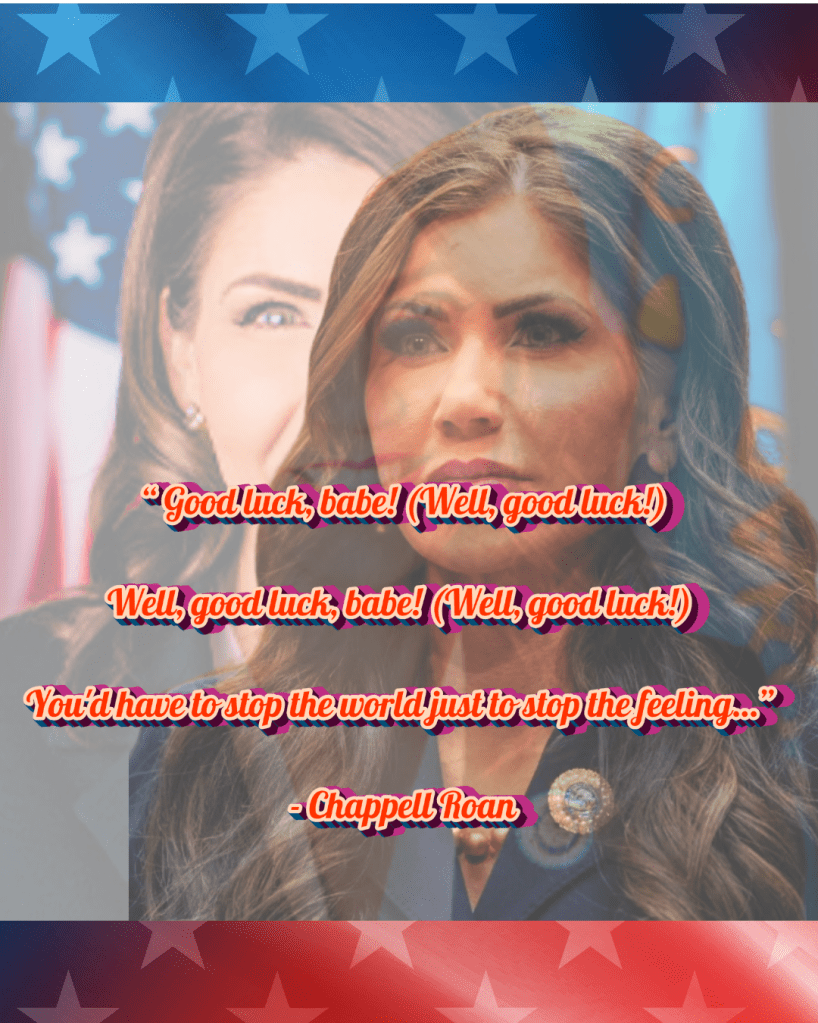
When South Dakota Governor Kristi Noem appeared on national television defending the story of how she shot her dog, critics quickly pointed to the inhumanity, the poor political judgment, and the tone-deafness. Noem didn’t back down. She doubled down, calling the backlash “a hit job,” accusing the media of bias, and reframing the act as tough but necessary. What’s striking isn’t just the original story; it’s the refusal to show vulnerability, even when the moment begged for it.
This pattern isn’t unique to Noem. It fits a growing archetype in American politics: the MAGA-aligned woman who projects absolute control, aesthetic perfection, and unwavering loyalty to a rigid political identity. This persona blends traditional femininity with a stoic, sometimes aggressive toughness. Think filler-smooth skin, pageant hair, crisp blazers, or, in some cases, baseball caps and camouflage. It’s a look and a language that says: I’m strong. I’m composed. I’m on your side.
But what does it cost to maintain that image?
As someone interested in both political identity and body-based psychological stress, I see something beneath the surface of this performance, something not often acknowledged in political commentary: the profound mental and emotional toll that comes with performing the right kind of womanhood in a male-dominated movement.
MAGA women are often celebrated for their “authenticity,” but the range of acceptable expression is very narrow. They can be assertive but not too emotional, beautiful but not vain, loyal but never fully independent. The ideal MAGA woman is both strong and deferential, polished and relatable, maternal and militarized.
She can wear a ballgown or field dress a deer as long as she keeps smiling and doesn’t challenge the men in charge. Any deviation, emotional expression, visible aging, or political dissent risks being seen as betrayal.
This is a corridor, not a platform. And walking it requires vigilance.
Kristi Noem’s public face, metaphorically and literally, reflects that vigilance. Her facial appearance has visibly shifted over the years: a smoother forehead, fuller lips, sharper cheekbones, and refined features that likely reflect some combination of Botox, dermal fillers, and perhaps surgery. While cosmetic intervention is common and not inherently problematic, its purpose here seems strategic. Her face is not just about beauty. It’s about control.
In psychiatry, there is something called “performance of regulation.” People under chronic stress often present as high-functioning, composed, or even over-achieving. But their emotional lives may be tightly restricted or completely internalized. They stop showing the world their feelings because they’ve learned that doing so leads to rejection, punishment, or loss.
In this context, Noem’s rigidity, unwillingness to admit fault, scripted language, and perfectly groomed appearance may be more than branding. It may be a form of psychological bracing, a way to survive the performance without letting anything real slip through the cracks.
Even if Kristi Noem appears composed and denies feeling pressure, the framework around her—the MAGA aesthetic, the gender expectations, the frozen face—points to a very narrow definition of success. Anyone walking a narrow corridor for too long eventually feels the walls closing in.
It’s important to understand that the MAGA woman’s aesthetic, whether Tomi Lahren’s tough-girl confidence or Noem’s high-gloss pageantry, isn’t just about vanity. It’s a survival strategy.
In male-dominated political spheres, women are rarely judged on ideas alone. Appearance becomes a silent resume. Studies have shown that female politicians are more likely to be evaluated on their looks, age, and tone of voice than their male counterparts. They must be camera-ready, emotionally contained, and hyper-disciplined to be considered credible. Add conservative gender politics into the mix, and the expectations become even more rigid.
For many of these women, altering their appearance is not an indulgence; it’s compliance. It’s a way to mute criticism before it starts. A face that doesn’t move can’t show fear. A body that doesn’t age can’t be dismissed. A look that fits the mold gets them closer to the power they’ve been told they should want but remains just out of reach.
What’s often overlooked in this conversation is the disappearance of the private self. When the public performance becomes all-consuming, the woman inside it can start to vanish. She can’t show sadness, confusion, or doubt. Her image is too valuable. Her message is too carefully shaped.
Psychologically, this performance is punishing. I’ve spent years, and no small amount of money, in therapy trying to unlearn the instinct to curate myself for the comfort of others. I often talk to my therapist about how I can walk into a room and immediately scan for what version of me will be most acceptable. I rarely choose authenticity over safety.
That hollow space women know too well, that tight internal silence we carry beneath our polished surfaces, isn’t just personal. It’s architectural. It’s carved out of us to hold up the space where the patriarchy gathers. It leaves little room for softness, grief, uncertainty, or rest. Even as we achieve, we feel disposable. Even as we succeed, we disappear.
When you build a self designed to be palatable, you forfeit your own hunger. Your body becomes a billboard. Your voice gets rehearsed. Your emotions are pushed into storage while you’re on high alert, watching yourself be watched, managing the performance, hoping no one sees the cracks.
It’s not hard to imagine how this applies to someone like Noem. Her image is so carefully managed that any deviation, from the dog story to a stray wrinkle, is treated as a flaw and a threat to the brand. That’s not just a political calculation. That’s a psychological burden.
We don’t know Kristi Noem’s internal life. But we do know the patterns that high-control performances demand. So we can ask:
What must be sacrificed to maintain this level of image control? Likely: rest, reflection, emotional range, private error.
What parts of herself is she not allowed to show? Likely: anger that isn’t scripted, vulnerability that isn’t staged, fatigue, softness, uncertainty.
And how sustainable is it, really? Not very. Performances this airtight eventually crack. And when they do, the backlash is often swift, not just from critics, but from within the self.
The problem isn’t Kristi Noem’s unnatural face or Tomi Lahren’s aggression. The problem is that the system rewards only a narrow version of womanhood, which mirrors male expectations rather than challenges them.
When conservative women say they’re “not like other girls,” they’re often saying: I’m not going to disrupt the hierarchy. And the reward for that alignment is short-term power and long-term invisibility. It’s a bargain: fit in and be seen but never fully known.
This kind of alignment is especially fraught in the MAGA world, where women are often used as proof that the movement isn’t sexist but are rarely given the latitude to lead outside the approved script. They can rise high only if they remain legible to the men who built the stage.
It’s easy to mock this aesthetic or write these women off as complicit. But I’d argue for a more compassionate frame. These women respond to the same pressures many of us feel, just in higher resolution. They are managing chronic exposure, identity stress, and aesthetic control in an environment that demands perfection but offers no safety net. They are walking that narrow corridor on a tightrope in expensive heels.
Rather than shame them, we should name the structure they’re operating inside. It is built on the foundation that insists women be visible, but only in a very specific light, paid for with the currency of femininity that devalues the woman who spends it. This structure claims to celebrate strength but punishes all forms of emotion that don’t uphold the framework.
Real power for women doesn’t come from walking a narrow corridor, bumping into the walls, pretending we don’t feel claustrophobic. It comes from breaking down the corridor walls so more people can fit in the space.
Kristi Noem may never admit to pressure. She may never drop the performance. But that doesn’t mean the cost isn’t there. If anything, the perfection of her image—the smooth skin, the firm tone, the refusal to apologize—suggests how much has been invested in keeping the mask intact.
The story worth telling isn’t just about politics. It’s about what happens to a person when the self becomes a strategy, and the strategy becomes the only way to be seen. It’s the story of what happens when survival demands a mask for performance, a mask so tight it leaves no room to breathe. In a media landscape that rewards spectacle over substance and image over integrity, women like Kristi Noem become symbols long before they are allowed to be people. The pressure to embody a seamless, legible identity, tough but not threatening, beautiful but not aging, loyal but not autonomous, distorts the self and the conversation.
This distortion doesn’t just affect the individual. It shapes what policies are pursued, which voices are amplified, and how legitimacy is defined in public life. When political power is built on curated perfection, authentic dialogue collapses. Vulnerability is edited out. Humanity is filtered. And the electorate, too, begins to confuse the image with the truth.
We don’t have to act out the roles they wrote for us, but we shouldn’t shame the women who memorized the entire script. Compassion isn’t a weakness; it’s a rebellion. And maybe the most radical thing we can do is look at another woman, especially a woman like Kristi Noem, not to shame, approve, or excuse, but to see her fully and refuse to look away.
Discover more from Mocktail Hour with Amy Abeln
Subscribe to get the latest posts sent to your email.

“paid for with the currency of femininity that devalues the woman who spends it.” DAMN!
LikeLike