Across the earth, exhaustion has become a way of life. Westernized humans call it ambition, discipline, or self-care, but beneath that language runs a quieter truth: capitalism has colonized our emotions. From therapy-speak productivity culture to beauty-as-brand, the market governs labor and feeling. I learned that the hard way, discovering that my relationship to beauty, desire, and worth was governed by the same logic Karl Marx described two centuries ago.
I first met Marx in a college course called Literature of Socialism in 1996. I was twenty-one and already understood how value attaches to visibility. Theory promised me an explanation for the ache I carried, the experience of being both object and observer, of realizing that my value followed beauty and attention more than intellect or effort. Reading The Marx-Engels Reader beside Nguyễn Du’s The Tale of Kiều, I saw the same machinery at work: women’s bodies turned into currency, virtue traded like gold. Kiều sells herself to save her family, and her beauty becomes her bondage. It was the first time I recognized my reflection in a system’s design.
Years later, I tore up that old Marx reader to make paper flowers. I thought I was finished with theory, that intellect belonged to another life that prized reason over instinct. I wanted petals instead of pages, beauty instead of rigor. I didn’t realize I was reaching for both by reaching for one. My body was rebelling against a world that measures worth through productivity.
The return wasn’t planned. It came through my community and our reactions to the state of the country, through conversations that reminded me why theory ever mattered. Marx quietly slipped back into my life, a translation for what we are all witnessing: exhaustion mistaken for living, neighbors stretched thin under the invisible weight of ordinary life. When I went home to find my Marx-Engels Reader, it sat thinner than I remembered, its edges uneven. I had forgotten that I’d torn it up for art’s sake. The spine remained, but whole sections were gone, turned to paper flowers long since given away.
The missing pages felt like a metaphor for what had happened to us; that theory had moved off the page and into our bodies. The mode of production had become a mode of feeling, and I traced its pulse in the people around me. Capital isn’t only an economic structure; it’s a parasite that feeds on how we relate to ourselves and each other. It trains the senses to recognize value through output and affection through transaction. The factory exists inside the nervous system.
When I read Marx at twenty-one, alienation meant the worker’s distance from their labor. Now I understand it as the distance between myself and my own aliveness, the inner part of me that knows and feels freely. Capitalism doesn’t only own the hands; it occupies our feelings. It teaches us to manage emotions like output and audit our hearts until joy feels supervised. The more I strive to be desirable, the more I become my own factory supervisor, producing versions of myself that perform value while burying the rest.
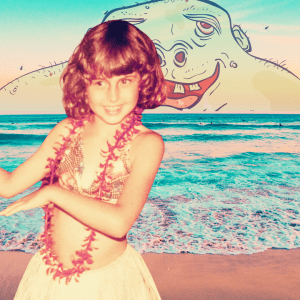
This conditioning didn’t start in adulthood; it began when the world taught me that my body could be read for value. I was seven when my body entered the marketplace. A friend’s father asked me to take off my swimsuit because I was “so pretty.” I refused and ran, but I learned an early lesson: my body was valuable, yet that value wasn’t mine to define. Compliments became transactions; smiles were signals. Beauty became a social language that translated into safety or exclusion, belonging or danger. I learned to speak it fluently long before I understood the labor of feminine performance.
At fifty-one, I now map the emotional economy. Beauty, discipline, and self-improvement function as social currency, tokens in capitalism’s emotional market. The system turns self-work into value by rewriting vitality itself as labor. Intellectually, I know this. Yet my body remembers something older: the pulse that rises when someone’s gaze lingers, the instinct that whispers, if I am radiant, I will be wanted. It isn’t vanity. It’s the memory of an equation rehearsed before I had the language for it.
That confusion is the system’s design. It feeds on the human need to be seen, turning intimacy into performance and desire into demand. The nervous system can’t distinguish between being loved and being liked, between connection and approval. Capitalism exploits that blur. It teaches us to polish what was once instinct and to market what was once mutual. The longing to be witnessed, once a survival signal, is now the engine of an economy built on emotional display. Every improvement becomes proof of worth; every shimmer, a plea for recognition. Self-care is now another shift at the factory.
Capitalism doesn’t only exploit resources; it occupies the senses. It trains us in what to fear, what to want, and what to overlook. The result is emotional automation: we perform affection the way we perform productivity, constantly auditing our visibility. Healing isn’t escape from the system; it’s rewiring the circuitry it left within us.
That’s where my private rituals live. I don’t often say it, but I read tarot and practice Reiki. These are my calibration tools, gateways to what I call the Inner Arcanum, the reservoir of quiet knowing that lives beneath fear and social conditioning. Tarot reminds me of what I already know. Reiki taught me how to breathe after my dad died, how to feel energy move through emptiness. These practices don’t fix pain; they soften it. They remind the body of what capital tried to erase: attention is not productivity, feeling is not a transaction, and presence generates value no market can price.
If capitalism rewires the body for production, the Inner Arcanum is where we reclaim its original circuitry. When attraction stirs in me now, I notice the reflex to perform. I ask whether radiance expands my freedom or returns me to the role of product. Performance, especially of desirability, is the unpaid labor women have always done. We know how to shine for survival. The harder practice is staying luminous without outsourcing the light.
To remain the source of my glow is a quiet revolution. It’s the difference between radiance as transaction and radiance as truth. Each time I choose presence to myself over performing for others, I reclaim a fragment of the emotional infrastructure that the market privatized. Small acts like drawing a tarot card or placing my hands over my heart retrain my senses to value attention, slowness, and breath. They undo capitalism’s oldest lesson: that worth must be earned.
Consciousness is the bridge between the emotional and the structural. Healing that disowns pain is only another form of extraction. Real healing stays faithful to the wound until it yields meaning. I think of consciousness like mycelium: the unseen network where matter remembers itself, where grief becomes intelligence, and new forms of knowing begin to grow.
Living from the Inner Arcanum means remembering that we are the same material as empathy, discernment, and repair. It means learning to sense the world without trying to own it and allowing perception to be relational rather than extractive. Under capitalism, feelings and meaning have been separated: the sensory is reduced to stimulation, the spiritual is dismissed as inefficiency, and the emotional is cut off from the economic. To heal that split is to reunite what was never meant to be divided: to feel with depth without turning that feeling into a transaction, to recognize that how we touch, see, and care are forms of knowing with their own value. The work is not to escape the system but to reinhabit ourselves so completely that the system loses all claims to our existence.
Capital may still govern production, but liberation begins when perception slips its control.
Discover more from Mocktail Hour with Amy Abeln
Subscribe to get the latest posts sent to your email.
